


Have you recently talked to a colleague who mentioned their firm’s remote legal staff in Central America? Did you wonder how it works and why they are using legal remote teams? If so, you’ve come to the right place. In this article, we will discuss how law firms use remote legal staff to increase efficiency, optimize costs, and retain top-tier talent.
Remote legal staff include remote paralegals, virtual legal assistants, and nearshore legal intake specialists, among others. They are essential for firms that want to reduce overhead, improve client responsiveness, and stay competitive.
The Rise of Remote Legal Staff in Modern Law Firms
According to the Robert Half 2025 Legal Salary Guide, the median salary for paralegals in major metropolitan areas reached $62,500 in 2024—a 12% increase from 2022 levels. When factoring in employer-paid benefits (health insurance, retirement contributions, payroll taxes), the true cost exceeds $85,000 annually per employee. Legal assistants with 3-5 years of experience command $55,000-$70,000 in base salary, with total compensation approaching $95,000 in competitive markets like New York, Los Angeles, and San Francisco.

The average small law firm cannot compete with the compensation packages offered by large firms, making it harder to find qualified staff at reasonable rates. The modern law firm no longer relies solely on in‑house staff for a multitude of reasons. Increasing hiring costs, labor shortages across the U.S., and the demand for specialized roles have turned the hiring landscape upside down.
For this reason, we have seen many Law Firms turned to remote legal staff to perform a variety of roles that were previously handled internally. Remote legal staffing has shifted from a nice‑to‑have to an operational necessity, helping firms significantly reduce overhead while maintaining productivity.
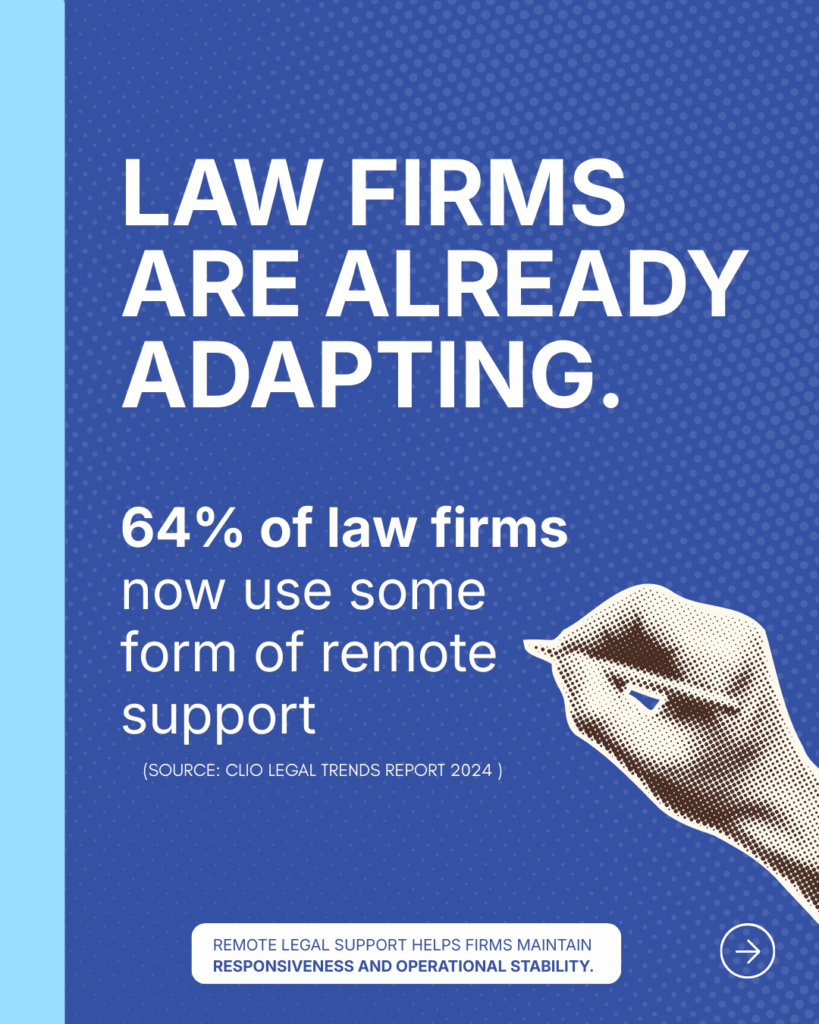
According to the 2024 Clio Legal Trends Report, which surveyed 2,503 legal professionals between May and June 2024, 64% of law firms now utilize some form of remote staffing.
Law firms have also reduced overhead costs by downsizing office space as more staff work remotely. Industry reporting on legal technology adoption highlights how firms are lowering rent and utility expenses by leveraging remote workflows and cloud-based systems
Types of Remote Legal Staff
Remote legal staff cover a wide variety of roles. Let’s break down the key positions firms commonly hire through remote staffing.
Remote Legal Assistants
Remote legal assistants are among the most frequently hired roles in remote staffing. They serve as the generalists of a law firm.
They perform administrative and legal support tasks that keep cases, calendars, and documents organized. They free attorneys from routine work, allowing them to increase their billable hours while essential administrative tasks continue to move forward.
What they do:
- Manage calendars, deadlines, and scheduling
- Format, proof, and prepare legal documents
- Handle client communications and follow‑ups
- Maintain case files and task lists
- Support billing, time entry, and workflow updates
How they support law firms:
Remote legal assistants reduce the administrative backlog that slows lawyers down, allowing attorneys to stay focused on drafting, strategizing, and client representation.
This shift aligns with broader industry trends. According to data published by the American Bar Association, a significant majority of law firms now support some form of remote work, and the U.S. Bureau of Labor Statistics reports that a growing share of legal professionals operate in hybrid or fully remote environments.
Virtual legal assistants support this transition by providing dedicated administrative and operational support without the fixed costs associated with traditional in‑house hiring.
Remote Paralegals
Remote paralegals are legal technicians trained to handle substantive legal tasks under attorney supervision. They take on deeper, case‑critical work that requires legal knowledge, not just administrative ability.
What they do:
- Legal research and memo drafting
- Draft discovery responses, pleadings, and motions
- Prepare evidence binders, chronologies, and trial materials
- Manage discovery review and document production
- Draft contracts, correspondence, and summaries
How they support attorneys:
Remote paralegals reduce attorneys’ billable‑hour load by handling legal tasks that don’t require bar licensure but do require precision. They are especially valuable during litigation, heavy discovery cycles, or document‑intensive matters. Virtual paralegal models can save firms substantial overhead per year per position while maintaining the consistency of a full-time team member.
Legal Intake Specialists
Remote legal intake specialists focus entirely on turning leads into qualified clients. They manage the front end of the client journey with speed, empathy, and consistency. Intake is the core of every firm, but something attorneys rarely have time for, and other administrative staff often prefer not to handle.
What they do:
- Answer inbound calls, chats, and form submissions
- Pre‑screen leads based on practice‑area criteria
- Schedule consultations
- Follow up with warm leads
- Track potential client data in the CRM
How they support attorneys:
Remote intake specialists dramatically improve conversion by ensuring every lead receives immediate attention. Fast response is critical, especially for firms specializing in PI, immigration, employment, or criminal defense.
Legal Admin Support
Legal admin support roles are the operational backbone of a law firm. They focus on systems, compliance, and administrative processes that keep the office running smoothly.
What they do:
- Data entry, file organization, and document management
- CRM maintenance and workflow updates
- Billing and invoice support
- Administrative compliance tasks
- Coordination between departments or teams
How they support attorneys:
Legal admin assistants centralize and streamline workflows so attorneys don’t get slowed down by backend operational tasks. They help ensure that systems stay up to date and that attorneys always have accurate, accessible information.
Why Law Firms Are Adopting Remote Legal Staffing
Here are some of the main reasons law firms integrate remote legal staffing into their business models.
Cost Efficiency Without Quality Loss
Latin America has become a key region for nearshore staffing as companies increasingly shift operations to access skilled professionals at more competitive costs while maintaining productivity and operational efficiency. Nearshoring to Latin America continues to expand across professional service industries, including legal support, (Miami Herald).
For law firms, staffing is one of the largest operational expenses. The U.S. Bureau of Labor Statistics reports that legal assistants and paralegals earn over $60,000 annually on average, excluding benefits and overhead.
In this context, remote legal staffing has become a practical solution for firms seeking to maintain high‑quality operations while controlling overhead. Virtual legal assistants allow firms to reduce fixed employment costs and scale support more efficiently, avoiding many long‑term financial commitments associated with in‑house hiring
Access to Specialized Skills
Remote legal staff offer a wide range of specialized skills — one of the most valuable being bilingual support. The U.S. has the second‑largest Spanish‑speaking population in the world, and access to bilingual talent allows firms to support clients they previously could not serve effectively.
Flexibility During High‑Volume Case Periods
Remote staffing models allow for flexible hiring during high‑capacity seasons. Firms can take advantage of fractional hiring or call‑center‑style staffing to increase capacity without committing to full‑time hires. This gives firms the ability to scale up or down as business needs change.
How Remote Legal Staff Improve Daily Operations
Streamlined Case Management
Remote legal staff play a pivotal role in reducing the administrative load that often slows attorneys and paralegals down. By handling tasks such as updating case files, managing calendars, organizing documents, and maintaining communication logs, they keep case data accurate and accessible. This helps attorneys stay on track with deadlines, hearings, and filings.
Faster Client Intake & Lead Response
One of the most impactful operational improvements remote legal staff deliver is accelerated intake. Dedicated legal intake specialists ensure no call, form of submission, or inquiry slips through the cracks. They pre‑screen potential clients, qualify leads, schedule consultations, and follow up promptly.
These tasks, often assigned to entry‑level employees, directly impact revenue and require precision and care.
According to research published by Clio, 68% of clients care more about attorney responsiveness than physical location, and response time plays a critical role in whether a prospective client retains a firm.
Eliminating Attorney Bottlenecks
When attorneys are pulled into administrative or repetitive tasks — scheduling, follow‑ups, drafting routine documents, sorting emails — firm productivity suffers. Remote legal staff remove these bottlenecks by taking on these tasks efficiently and consistently.
Remote staff ensure attorneys spend more time on high‑value activities like strategy, negotiations, court preparation, and client representation — rather than administrative burdens that stall firm growth.
In‑House vs. Remote Legal Staff
Choosing between in‑house staff and remote legal professionals requires understanding how each model impacts operations. Below is a comparison based on cost, efficiency, availability, and scalability.
Total Cost Structure
In‑house staff are significantly more expensive. You must factor in salaries, benefits, office space, equipment, payroll taxes, and the liability of full‑time employment. Finding qualified in‑house staff at reasonable costs is one of the most common challenges firms report.
Remote legal staff reduce this burden and deliver significant cost savings. While offshore vs. nearshore costs vary, finding high‑quality team members is typically worth accepting slightly reduced savings to maintain seamless operations.
Reliability
Reliability comes down to consistency, response time, and commitment to the role. Qualified remote legal staff in Central America often view these positions as high‑level career opportunities. These professionals are not entry‑level; they have established careers in customer service, administration, and the legal field.
In‑house staff may use administrative or intake roles as a stepping stone to more senior positions later, leading to higher turnover or dissatisfaction — making remote staff a more ideal fit for intake and admin roles.
Coverage Hours
In‑house teams are typically limited to 8 a.m.–5 p.m. When calls or leads arrive outside those hours, attorneys either handle them personally or they go unanswered.
Remote staffing allows firms to choose coverage models that match demand:
- Nearshore teams extend coverage beyond U.S. hours
- Intake specialists can support near‑24/7 responsiveness
Bottom line: Remote staffing offers flexible, extended‑hour coverage.
Scalability
In‑house hiring is slow, rigid, and expensive. Recruiting can take months, and firms must commit to long‑term overhead even during slower periods.
Remote staffing models scale seamlessly:
- Staffing companies maintain strong candidate pipelines
- The legal outsourcing industry continues to grow
- The average time from recruitment start to onboarding is about four weeks
When Remote Legal Staffing Makes the Most Sense
Several indicators show when firms should consider remote legal staffing.
Firms with High Marketing Spend but Low Conversions
Industry marketing benchmarks indicate that the average law firm spends roughly 2% of revenue on marketing, while high-growth firms may invest over 16%, compared to about 5% among firms experiencing little or no growth
Low conversion typically indicates:
- Intake staff are overwhelmed
- Internal teams are disengaged
- Leads are falling through the cracks
Remote legal staff increase conversion by providing the consistent coverage and care each lead requires, allowing firms to maximize their marketing investment.
Overloaded Attorneys Doing Admin Work
Many attorneys don’t anticipate the volume of administrative work required when running a firm. Between payroll, tax filings, and day‑to‑day administrative tasks, attorneys quickly become overloaded.
Hiring remote legal staff allows attorneys to offload administrative duties, regain billable time, and significantly reduce stress.
Solo & Small Firms Trying to Compete with Larger Firms
According to the U.S. Bureau of Labor Statistics, employment for paralegals and legal assistants is projected to grow modestly between 2023 and 2033, reinforcing the steady demand for legal support professionals
Conclusion
Law firms that integrate remote paralegals, legal assistants, and intake specialists are expanding capacity, improving responsiveness, and protecting attorney time. When implemented correctly through a trusted Nearshore recruiting agency, remote legal staff become a seamless extension of your firm. They increase efficiency, strengthen client experience, and allow attorneys to focus on high-value legal work instead of administrative bottlenecks.
Ready to explore remote legal staffing for your firm? Vivaro is here to help
FAQs
- Are remote legal staff qualified to support U.S. law firms?
Yes. Remote legal staff are experienced professionals with years of legal and administrative expertise. Vivaro Nearshore sources candidates specifically matched for your law firm’s needs. - How does remote legal staff maintain confidentiality?
Our employees sign NDAs and undergo federal background checks in El Salvador. We hire talent committed to confidentiality and compliance. - What roles can be outsourced safely?
Legal intake, legal admin, remote paralegals, and executive assistants can all be safely outsourced. - Do remote staff work U.S. hours?
Yes. Remote legal staff in Central America work U.S. hours, as they are primarily in CST time zones.

This content was developed by the Vivaro Nearshore content team in collaboration with our recruiting and operations specialists. Our articles reflect real experience placing bilingual professionals with U.S. small and mid-sized businesses.