


We’ve had the same conversation dozens of times. A firm owner or managing partner sits down with us, and within the first ten minutes they say some version of the same thing: “We would grow faster if we could just hire the right people.”, sound familiar?
We’ve helped growing law firms stop losing billable time to the wrong hires, and along the way, we’ve learned what it actually takes to build legal teams that hold.
Hiring and training legal administrative assistants in the U.S. can take months, taking also in consideration that often small firms do the recruiting them selves. And just when a new team member finally starts operating smoothly, they leave for a bigger firm offering a higher salary. That’s when deadlines slip, Paralegals carry overflow work, Attorneys stay late doing admin tasks.
One Law Firm’s Story, a Pattern We Keep Seeing
One of our clients in California had been hiring in-person for years. They weren’t looking for remote staffing, until we sat down and mapped out what was actually happening inside their firm. The problem was workload imbalance, their paralegals were spending too much time on tasks that should belong to a legal administrative assistant, causing burnout and billable hours lost.
That conversation is what led us to place their first remote legal administrative assistant. Two years later, they’ve expanded the team and delegated far more to that role than they ever expected when they made the first hire.
Curious whether your firm has a similar gap? Book a free consultation and we’ll map it out together.
The Real Hiring Landscape for Legal Administrative Assistants
Compensation expectations have climbed quickly. According to the Robert Half 2025 Legal Salary Guide, legal assistants with 3–5 years of experience earn $55,000–$70,000 in competitive markets. After adding benefits, payroll taxes, and overhead, firms often reach $90,000–$95,000 per year for a single role.
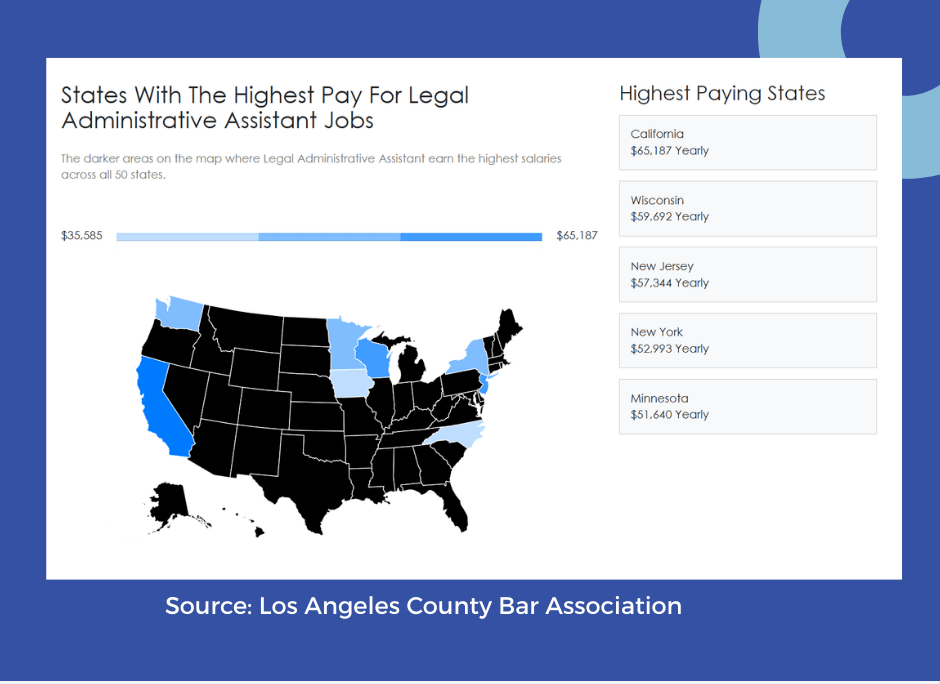
According to data from the Los Angeles County Bar Association, the national average salary for a legal administrative assistant is $50,274, but in California, that number climbs to $65,187, making it one of the most expensive states to staff in.
And demand isn’t slowing. According to the U.S. Bureau of Labor Statistics, the field is projected to generate around 39,300 job openings for paralegals and legal assistants annually through 2034, meaning competition for qualified talent will remain strong for years to come.
For smaller firms, keeping up with salary competition is difficult, and retention becomes unpredictable, so operational stability suffers as a result.
How Much Does a Legal Administrative Assistant Actually Cost?
This is one of the first things firm owners ask when we sit down with them, and the honest answer is: more than the salary line suggests.
The U.S. Bureau of Labor Statistics puts the average annual salary for paralegals at $60,000, excluding benefits. For legal administrative assistants, that number is lower, but the full cost picture follows the same pattern. Based on our work placing legal administrative assistants with U.S. law firms, the true annual cost typically breaks down like this:
- Base salary: $50,000–$70,000 depending on market and experience
- Payroll taxes and benefits: 20–30% added on top
- Recruiting and onboarding: weeks of internal time, often plus agency fees
- Training: significant investment before the hire operates independently
- Turnover risk: if they leave within 12–18 months, the entire cycle starts over
All in, firms in competitive markets routinely spend well above the base salary figure before the role is even running at full capacity.
Remote Nearshore Staffing changes that equation considerably. In our experience, firms that have hired remote legal administrative assistants save significantly compared to equivalent U.S. hires, while getting professionals who are bilingual, tech-proficient, and aligned to U.S. time zones.
It’s worth noting that legal administrative roles were our most placed positions in 2025, and we maintain an 84% talent retention rate across our placements, which tells us this model isn’t just cost-effective, it’s stable.
Where Remote Legal Administrative Assistants Create Immediate Impact
A well-integrated remote legal administrative assistant not only supports attorneys but also relieves paralegals so they can focus on substantive, billable work. Here’s what we see most consistently across the firms we work with.
Protecting Paralegal Capacity
Paralegals handle legal research, drafting and editing, discovery support, and trial preparation. But many are also asked to coordinate calendars, format documents, follow up with clients, and update CRMs and case files.
When that happens, the firm ends up paying paralegal rates for administrative work. We’ve seen this pattern repeatedly, and it’s one of the clearest signs a firm needs a dedicated remote legal administrative assistant.
Improving Workflow Stability
Legal administrative assistants take ownership of deadline tracking, case file maintenance, filing preparation, appointment confirmations, and billing support. This creates predictable workflow and reduces last-minute scrambles.
Supporting Bilingual Clients
Spanish is the second most spoken language in the U.S. (U.S. Census Bureau). In states like Florida, California, or Texas, bilingual support isn’t a bonus—it’s essential.
Nearshore professionals in Latin America offer strong English–Spanish fluency, cultural alignment with U.S. clients, and full time zone overlap. In the California case we mentioned earlier, bilingual capability was one of the deciding factors. It immediately strengthened their client intake process.
How We Place a Full Time Legal Administrative Assistant
We start with a consult to understand your firm’s practice area, caseload, and workflows, then we design the role around those specifics, not a generic job description. This is what we call tailored recruiting: every search is built around your team dynamics, growth stage, and the exact gap you need to fill. From there, our recruiting team searches across multiple platforms, screening each candidate for experience, skills, communication style, and fit. We join you for every interview and once you’ve selected your hire, we manage onboarding end to end: KPIs alignment, equipment, software setup, and HR compliance in El Salvador. Your firm focuses on role-specific training. From day one, your team member works onsite from our offices, with Vivaro managing payroll, IT support, benefits, and performance oversight.
The candidate we placed for our California client didn’t come from a legal background. But she was sharp, professional, proficient in the CRMs the firm used, and genuinely motivated. Leading firms like White & Case have noted that the best legal assistants succeed not through legal pedigree alone, but through the ability to multitask, exercise good judgment, and work effectively across teams. We’ve seen that firsthand.
We chose to prioritize aptitude, communication, and ownership mentality. The client understood that strong onboarding would close the familiarity gap, and it did.
When a Nearshore Legal Administrative Assistant Is the Right Move
Based on the firms we’ve worked with, the signals are usually consistent. You may be ready if:
- Your paralegals are overwhelmed and carrying tasks below their level
- Admin work is slowing case progress
- Local hiring feels unpredictable or financially unsustainable
- Turnover is increasing and affecting team morale
- Attorneys are spending time on coordination instead of legal work
And if you’ve already been asking “how much does a legal assistant cost?”—that question alone is usually the signal that the current model isn’t working.
Before you post that job listing
What we’ve learned working with law firms across the U.S. is that the bottleneck is rarely the caseload, but the support structure underneath it.
A full time legal administrative assistant, placed and managed the right way, is one of the highest-leverage hires a growing firm can make. With nearshore, you get that leverage without the cost ceiling that’s been slowing you down.
If your firm is ready for more stability and less hiring stress, let us walk you through what that could look like for your specific team.
Vivaro Nearshore helps U.S. law firms build reliable remote legal teams through tailored recruiting, structured onboarding, and ongoing HR management. If you’re evaluating nearshore staffing, we’re here to help.

This content was developed by the Vivaro Nearshore content team in collaboration with our recruiting and operations specialists. Our articles reflect real experience placing bilingual professionals with U.S. small and mid-sized businesses.